<?xml version='1.0' encoding='UTF-8' ?>
<feed xmlns='http://www.w3.org/2005/Atom'>

	<id>http://der-dakon.net/blog/kde.xml</id>
	<title>Dakons blog</title>
	<link href='http://der-dakon.net/blog/'/>
	<link rel='self' href='http://der-dakon.net/blog/kde.xml'/>
	<updated>2014-10-03T15:01:06+02:00</updated>

<entry>
	<author><name>Dakon</name></author>
	<id>http://der-dakon.net/blog/KDE/marvelous-marble.html</id>
	<title>Marvelous Marble</title>
	<link href='http://der-dakon.net/blog/KDE/marvelous-marble.html'/>
	<published>2014-10-03T14:55:57+02:00</published>
	<updated>2014-10-03T15:01:06+02:00</updated>
	<content type='html'><![CDATA[
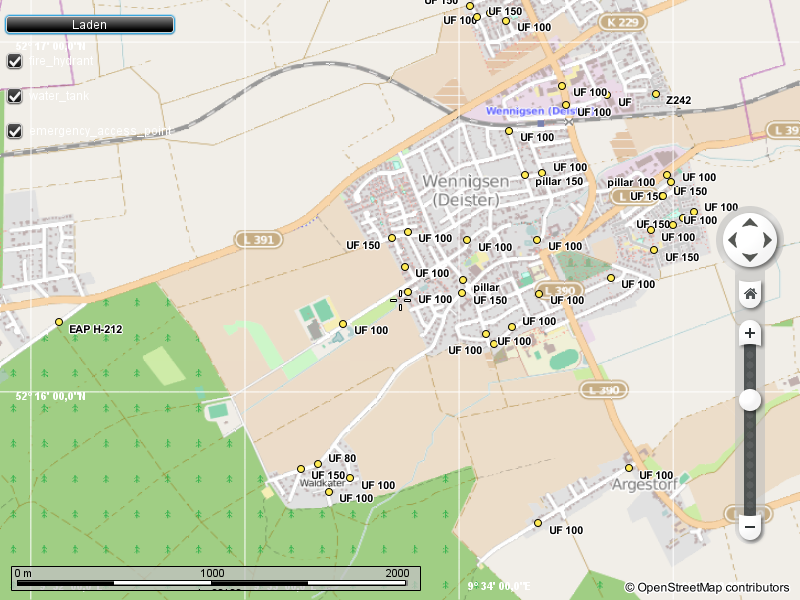
<p><img width="800" height="600" alt="OSMhyd showing hydrants in Wennigsen (Deister)" src="http://opensource.sf-tec.de/osmhyd/osmhyd-v1.png" style="float: right; padding: 10px" /></a>
I'm one of those persons that always prefers a native application over some web stuff. Usually this comes from some things I want to have, may it be speed, offline capabilities or just hacking possibility. So as a long-time user and contributor of <a href='http://www.openstreetmap.org'>OpenStreetMap</a> as well as an <a href='http://atemschutzunfaelle.eu/wirueberuns/redaktion.html#reb'>active firefighter</a> I of course know about <a href='http://www.openfiremap.org'>OpenFireMap</a>. And of course I want a local version of it.</p>
<p>Well, the way to go is obvious for a KDE hacker, no? Right, using <a href='http://marble.kde.org'>Marble</a>, or better: using libmarble as explained in the  <a href='https://techbase.kde.org/Projects/Marble#With_C.2B.2B'>KDE Techbase</a>. So, what did I end up with? A small pure-Qt application that uses libmarble to display OpenStreetMap tiles, showing some custom placemarks. Those placemarks are collected directly from the OpenStreetMap (online) database using the <a href='http://overpass-api.de/'>Overpass API</a>. Then a bit of brute-force XML parsing using <a href='http://qt-project.org/doc/qt-4.8/QXmlStreamReader.html'>QXmlStreamReader</a> and then: pure awesomeness.</p>
<p>This currently is based on Qt4, therefore I use XML and parse it brute-force. Eventually I'll switch to a Qt5-based libmarble, and will use the <a href='http://qt-project.org/doc/qt-5/json.html'>builtin JSON-support of Qt5</a>. And maybe one day I'll finally find an example on how to draw different graphics for different types of placemarks.</p>
<p>Of course, this is not entirely local. But the information about the extra placemarks can easily be saved locally and restored from there (in fact, that is what the first versions did before I starte using <a href='http://qt-project.org/doc/qt-4.8/QNetworkAccessManager.html'>QNetworkAccessManager</a>), and Marble caches the tiles so it will sort-of work even offline. And of course the source code is available for everyone to hack around with it: <a href='http://opensource.sf-tec.de/osmhyd/osmhyd-1.tar.xz'>OSMhyd version 1</a>.</p>
	]]></content>
</entry>
<entry>
	<author><name>Dakon</name></author>
	<id>http://der-dakon.net/blog/KDE/travel-time.html</id>
	<title>Travel time</title>
	<link href='http://der-dakon.net/blog/KDE/travel-time.html'/>
	<published>2013-10-04T08:12:48+02:00</published>
	<updated>2013-10-04T08:12:48+02:00</updated>
	<content type='html'><![CDATA[
<p xml:lang="en">Time to pack my suitcase today. I'll be on a family visit over the weekend and afterwards will head for Berlin where I'll be at the <http://www.qtdeveloperdays.com/ Qt Developer Days> from Monday to Wednesday. All the gearheads around that like to meet in person are welcome to drop me a note (in fact, also non-gearheads, albeit their small number). I especially welcome everyone that brings his or her GPG key fingerprint and wants to cross-sign keys with me.</p>
	]]></content>
</entry>
<entry>
	<author><name>Dakon</name></author>
	<id>http://der-dakon.net/blog/KDE/most-secure-tls-browser.html</id>
	<title>We have the most secure TLS-enabled browser</title>
	<link href='http://der-dakon.net/blog/KDE/most-secure-tls-browser.html'/>
	<published>2013-03-28T22:56:19+01:00</published>
	<updated>2013-03-28T22:56:19+01:00</updated>
	<content type='html'><![CDATA[
<p>Heise (The H) today released an <a href='http://www.h-online.com/open/news/item/Understanding-a-browser-s-crypto-preferences-1832604.html'>article about</a> a <a href='https://cc.dcsec.uni-hannover.de/'>TLS test site</a> from the University of Hannover. They mentioned that even newer browser don't support the 5 year old TLSv1.2 specification. Reason enough to fire up my collection of browsers and share the results.</p>
<ul>
<li>Opera 12.14 (Build 1738): TLSv1, DHE-RSA-AES256-SHA</li>
<li>Firefox 19.0.2: TLSv1, DHE-RSA-CAMELLIA256-SHA</li>
<li>Chromium 27.0.1425.0 (185065): TLSv1.1, DHE-RSA-CAMELLIA256-SHA</li>
<li>Konqueror 4.10.1: TLSv1.2, DHE-RSA-AES256-GCM-SHA384</li>
</ul>
<p>The article suggests that with some fiddling you can get Internet Explorer to support TLSv1.1 and TLSv1.2, but I can't test that because of the lack of a supported platform. So, out of the box we have the most secure TLS implementation available. We rock!</p>

	]]></content>
</entry>
<entry>
	<author><name>Dakon</name></author>
	<id>http://der-dakon.net/blog/KDE/kgpg-2012.html</id>
	<title>What have I done lately?</title>
	<link href='http://der-dakon.net/blog/KDE/kgpg-2012.html'/>
	<published>2013-01-05T21:10:45+01:00</published>
	<updated>2013-01-05T21:10:45+01:00</updated>
	<content type='html'><![CDATA[
<p>The <a href='/blog/KDE/how-to-get-trust.html'>last time I wrote about KGpg</a> is nearly a year back, so I thought I give it some attention again. What has happened meanwhile? Nothing too important, actually. I have fixed some bugs, introduced some new, fixed them also. I did some internal improvements, but nothing earthshaking. Last week I fixed signing keys, this was probably broken the whole SC 4.9 cycle but noone noticed. Finally I ported KGpg away from synchronuous calls to <a href='http://api.kde.org/4.x-api/kdelibs-apidocs/kdeui/html/classKPasswordDialog.html'>KPasswordDialog</a>, which I started at least 3 times before but never finished. Since starting gpg-agent is currently not happening automatically on login anymore in my openSUSE installations I was forced to fix it once I saw it fail.</p>
<p>While I was distracted from KGpg work I meanwhile did some stuff that likely most of you are already using, probably without noticing. I started pushing a bunch of patches to CMake which finally led to me getting write access to the repository, which in turn led to me doing even more cleanups there. Now most Find*.cmake modules have version selection support, the automatic handling of distinct debug and release versions for one module has been improved (wanted especially by the (KDE-)Windows people), and the usual amount of bug fixes, breakages, and fixes for these breakages have happened.</p>
<p>In the last few weeks I was going even one level deeper, heavily patching KWSys. This is likely something you have not heard of, but you are still using it. This is a collection of tool classes from Kitware (the guys behind CMake and other stuff) that handles platform abstraction. My point of interest was the SystemInformation class, which gives you things like logical and physical processor count (that is Hyperthreading processor vs. core), memory size and stuff like that. It started with getting some more beautiful information about my HP PA-RISC boxes (I own a Apollo 705, a C3600, and a C8000), then fixing some ARM processor flag stuff, finally adding CPU feature gathering to Win64, Irix, the BSDs, HP-UX, and AIX where they were almost entirely lacking before. And then doing the same for memory size for some of this system. Currently under review are some final cleanups to make the code more readable.</p>
<p>That's it from my side for the moment, let's see what happens next ;)</p>
	]]></content>
</entry>
<entry>
	<author><name>Dakon</name></author>
	<id>http://der-dakon.net/blog/KDE/choose-your-browser-bugs.html</id>
	<title>Choose your browser ... bugs</title>
	<link href='http://der-dakon.net/blog/KDE/choose-your-browser-bugs.html'/>
	<published>2012-07-31T21:58:12+02:00</published>
	<updated>2012-08-03T22:11:56+02:00</updated>
	<content type='html'><![CDATA[
<p>
<a href="http://der-dakon.net/blog/KDE/css-content-bugs.png"><img width="311" height="224" alt="Test page rendering in different browsers" src="http://der-dakon.net/blog/KDE/css-content-bugs.png" style="float: right; padding: 10px" /></a>
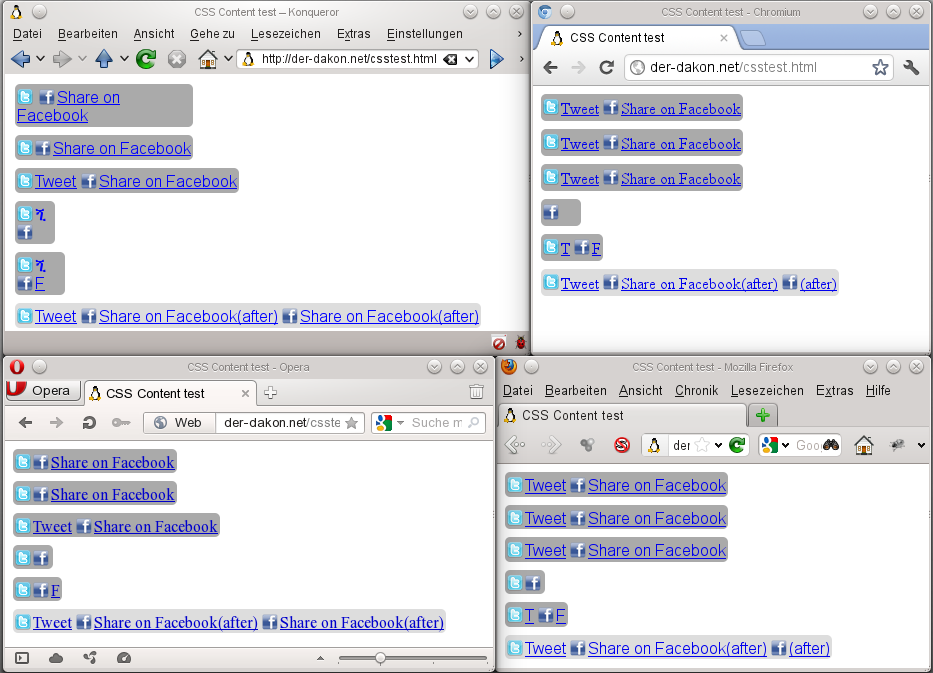
I was playing around with some <em>content</em> tags in CSS. Looks like I have been <a href='/blog/KDE/sometimes-there-is-progress.html'>wrong recently</a> when I said that Firefox still doesn't support it at all. In fact it looks like it is the only browser that does it all right.</p>
<p>So I created a <a href='http://der-dakon.net/csstest.html'>test page</a> and loaded it in 4 browsers. You see on the picture on top left Konqueror from KDE SC 4.8.4, Chromium 21.0.1145.0 (svn138062) to the right, bottom left Opera 11.64 (build 1403), and finally Firefox 12.0. Just in case anybody complains: I upgraded to Chromium 22.0.1190.0 (144885), Opera 12.00 (build 1467), and Firefox 14.0.1, but the rendering is still exactly the same. Benjamin Dietrich send me a screenshot showing that Safari 6.0 (8536.25) behaves exactly like Chromium. Patrick Spendrin sent in screenshots showing that Internet Explorer 8 and 9 behave the same as Firefox.</p>
<p>So, what's up there? If you download the file and comment out the <em>display:none</em> for <em>h1</em> you will see explanations what happens in the different versions of the test. I will just talk about the bugs here.</p>
<dl>
<dt>Konqueror</dt>
<dd>The width calculation is slightly wrong when the content is set to &quot;&quot;, which is done right when it is set to <em>none</em> (the first 2 boxes). This leads to a spurious linebreak. (Bug <a href='https://bugs.kde.org/show_bug.cgi?id=304357'>K1 (#304357)</a>)</dd>
<dd>When there is no content at all there is also the spurious linebreak. (Bug K2, example #4).</dd>
<dd>When there is no content at all the first elemtent shows a content that I have no idea where it comes from, possibly from invalid memory read? (Bug K3, example #4)</dd>
<dd>When there are 2 consecutive elements of the same classes that differ in their text Konqueror will completely ignore the text content of the second one and use the one of the previous (Bug K4, example #5 and last element of example #6)</dd>
<dd><a href='http://www.w3.org/TR/CSS21/generate.html#content'>CSS 2.1 spec</a> says <em>content</em> applies to <em>:before</em> and <em>:after</em> pseudo elements. Konqueror nevertheless applies it to the main element also if it is specified there. Which is fine as it is allowed in <a href='http://www.w3.org/TR/css3-content/'>CSS3</a> (<span style="text-decoration:line-through"><a href='https://bugs.kde.org/show_bug.cgi?id=304355'>K5 (#304355)</a></span>, example #1 and #2).</dd>
<dt>Chromium</dt>
<dd>if the elements have no contents element 2 is drawn on top of element 1, while the width of the <em>ul</em> that I use to hold the elements is big enough to hold both (bug C1, example #4).</dd>
<dd>Only supports CSS2.1 (examples #1 and #2)</dd>
<dt>Opera</dt>
<dd>shares bug K4. I assume this is also the reason why example #4 is rendered wrong here, the &quot;T&quot; text that should be there is just dropped because the previous example didn't have it, but the rest is rendered correctly. (Reported by Martin Riethmayer as Opera bug DSK-371115)</dd>
<dd><span style="text-decoration:line-through; padding-right: 0.5em">shares bug K5</span>Also supports CSS3.</dd>
<dt>Firefox</dt>
<dd>Pass.</dd>
<dd>Only supports CSS2.1 (examples #1 and #2)</dd>
</dl>
<p>What's missing? <span style="text-decoration:line-through">I have not seen what Internet Explorer and Safari do. I assume Safari will be more or less the same as Chromium.</span> And I have not reported all of these bugs yet. I'll do myself for the Konqueror bugs eventually, but will not do for any of the other browsers. If you would like to report any of these bugs anywhere please drop me a note so I can add links to the bug reports.</p>
<p><strong>Edit:</strong> K5 was actually E1: Opera and Konqueror support CSS3 generated content where this is allowed.</p>
<p><strong>Edit2:</strong> Added findings by other people and reference to Opera bug report.</p>

	]]></content>
</entry>
<entry>
	<author><name>Dakon</name></author>
	<id>http://der-dakon.net/blog/KDE/sometimes-there-is-progress.html</id>
	<title>Sometimes there is progress ...</title>
	<link href='http://der-dakon.net/blog/KDE/sometimes-there-is-progress.html'/>
	<published>2012-07-22T00:05:01+02:00</published>
	<updated>2012-07-22T00:05:01+02:00</updated>
	<content type='html'><![CDATA[
<p><a href="http://der-dakon.net/blog/KDE/bko-khtml.png"><img width="531" height="390" alt="Previous look of bugs.kde.org in KHTML" src="http://der-dakon.net/blog/KDE/bko-khtml_k.png" style="float: right; padding: 10px" /></a>
... but nobody notices. I've been subscribed to kde-core-devel for a while but KHTML development seemed pretty dead. Or have you heard of cool new things in Konqueror for a while? Also the KDE changelogs did not show anything of interest, besides some small corner case and crash fixes every now and then. I'm one of those people that still have Konqueror/KHTML as their default browser. I guess most people meanwhile have switched to something else, either the engine to Webkit or to a different default browser. One day our KDE bugzilla got an upgrade, a new style, and it looked even worse than before (see the footer in the image). I can understand if people have problems with Konqueror, there are way to many things that don't work, e.g. pages heavily using JavaScript (Twitter anyone?). I for my part don't like the Webkit part because it lacks some things like edit autocomplete because of missing interfaces in Webkit. Firefox drives me insane because of the missing clear buttons in edits. And it still does not support &quot;content&quot; in CSS as I found out yesterday. Unbelievable.</p>
<p>Some month back something unexpected happen: I saw a flow of patches for KJS flow in. And from what I see Bernd Buschinski does an awesome job implementing some stuff that has been missing for a while. He is not the only one working on KHTML/KJS these days, but the one who is mostly visible on kde-core-devel through his review requests and the one who made me look at this stuff. In fact I made an offline JS compliance test through CMake possible as the online test wasn't easily configurable to run only specific tests (or omit some that were not working at all). And I even fixed one or small absolutely minor compliance issues.</p>
<p>So even if you did not hear much about Konqueror for a while, there has been some progress. Here are some things I remember from the not too distant past that made my daily web experience better (or will do so as some of the patches are not yet in a released version). Too bad they have not been in the official changelogs, but better those guys keep fixing stuff and forget to write it down than stop fixing it ;)</p>
<ul>
<li>the maximum allowed stack size usable by KJS has been raised, making e.g. the twitter log of a person work again (fixed by Martin Sandsmark)</li>
<li>fix the usage of &quot;short&quot; variable type for position calculation which too easily overflows (fixed by Andrea Iacovitti, will be in 4.8.5 and 4.9.0, would have fixed the layout of e.g. bugs.kde.org)</li>
<li>after Andrea Iacovitti found out what is wrong Sayak Banerjee and Ingo Malchow fixed the CSS on <a href='http://paste.kde.org'>paste.kde.org</a> and <a href='http://bugs.kde.org'>bugs.kde.org</a> to not use <em>text-indent: -99999px</em> which would overflow the short, but smaller values getting the same effect, so this now even works with older Konqueror versions</li>
<li>the <em>onhashchange</em> event is now supported by Konqueror, adding support to even more JS heavy sites making probably e.g. even more twitter stuff working (done by Martin Sandsmark)</li>
<li>do not ask if a mailto: link is clicked, but just open the mail program (fixed by Martin Koller)</li>
<li>patches currently under review from Bernd Buschinski will e.g. add JSON support to KJS</li>
</ul>

	]]></content>
</entry>
<entry>
	<author><name>Dakon</name></author>
	<id>http://der-dakon.net/blog/KDE/I-assure-you-we-are-rocking.html</id>
	<title>I Assure You We're Rocking</title>
	<link href='http://der-dakon.net/blog/KDE/I-assure-you-we-are-rocking.html'/>
	<published>2012-02-06T21:52:21+01:00</published>
	<updated>2012-02-06T21:52:21+01:00</updated>
	<content type='html'><![CDATA[
<p>Do you remember <a href='/blog/KDE/konqueror-kicking-ass-again.html'>Konqueror kicking ass again</a>? Well, toda^Wyester^Wlast wee^W^Wnearly two weeks ago I got a mail by Julian Reschke, the guy behind all this HTTP conformance checks. He mailed me a link to <a href='https://plus.google.com/107651864577259151853/posts/3ohTcUacb6o'>one of his post at Google+</a>. This time we are rocking right from the start. Still some space for improvement, and I have already seen some additional bugs in that header parsing. Looks like I need to find some time to hack on this again.</p>
<p>If anyone wants to gather some good karma then showing up and writing some unit tests for those low level protocol stuff in any kioslave is surely appreciated. Bonus points if you know which film the title refers to.</p>
	]]></content>
</entry>
<entry>
	<author><name>Dakon</name></author>
	<id>http://der-dakon.net/blog/KDE/how-to-get-trust.html</id>
	<title>How to get trust</title>
	<link href='http://der-dakon.net/blog/KDE/how-to-get-trust.html'/>
	<published>2012-01-08T18:04:32+01:00</published>
	<updated>2013-01-05T20:37:06+01:00</updated>
	<content type='html'><![CDATA[
<p><a href='http://edulix.wordpress.com/2012/01/08/the-server-in-the-middle-problem-and-solution/'>Edulix's post</a> reminded me of something that we discussed in #kde-devel the other day. All this GPG signing stuff is based on the trust you have in other peoples keys.</p>
<p>The trust in those keys is much more obvious than e.g. in systems based systems: you can see who signed a key (and by that verified it), and you can even use websites showing you the possible trust paths between keys (e.g. <a href='http://pgp.cs.uu.nl/stats/69B9FC4E.html'>pathfinder</a>).</p>
<p>Now this signatures need to come from somewhere, i.e. people must sign their respective keys. This is something e.g. the Linux kernel developers are currently doing: only people with a trustworthy key are given write access to <a href='http://www.kernel.org'>kernel.org</a>. While Linus may not trust me (yet), from a global point of view I'm closer to everyone than he is: take <a href='http://pgp.cs.uu.nl/stats/69B9FC4E.html'>my key 69B9FC4E</a> and compare it to <a href='http://pgp.cs.uu.nl/stats/00411886.html'>Linus's key 00411886</a>. The avarage distance from anyone involved in the PGP web of trust for my key is 3.9, while his is 4.5. The reason for this is not only that my key is signed by more people, it's just that e.g. the <a href='http://pgp.cs.uu.nl/stats/AAE6022E.html'>fifth most signed key</a> is one of those.</p>
<p>Ok, now everyone is eager to get his or her key signed, but what to do about this? Well, when do you meet next with other geeks? Like a KDE release party? Development sprints? Bring your key, bring your identity card, sign and get signed! More details on this is e.g. in the KGpg documentation (on <a href='http://docs.kde.org/stable/en/kdeutils/kgpg/index.html'>docs.kde.org</a>, on <a href='http://userbase.kde.org/KGpg/Manual/Manage#Signing_keys'>KDE userbase</a>). Likely even in your language. If not, what about <a href='http://l10n.kde.org'>translating it</a>?</p>
	]]></content>
</entry>
<entry>
	<author><name>Dakon</name></author>
	<id>http://der-dakon.net/blog/KDE/nepomuk-considered-harmful.html</id>
	<title>Nepomuk considered harmful</title>
	<link href='http://der-dakon.net/blog/KDE/nepomuk-considered-harmful.html'/>
	<published>2011-07-14T09:08:11+02:00</published>
	<updated>2011-07-14T09:08:11+02:00</updated>
	<content type='html'><![CDATA[
<p>When I came to the office I wondered why a compilation of e2fsprogs failed. It was simply out of space. A only one month old 200G volume out of space? Well, what I found out was even harder to believe:</p>
<pre class='shell'>
$  ls -al .xsession-errors
-rw------- 1 ebeer users 202558869504 Jul 14 09:03 /home/ebeer/.xsession-errors
$  tail -n 2 .xsession-errors

(process:27881): GLib-WARNING **: poll(2) failed due to: Das Argument ist ungültig.

$  ps -p 27881
  PID TTY          TIME CMD
  27881 ?        1-01:40:51 nepomukservices
</pre>

<p>In case anyone wonders: that is &quot;invalid argument&quot; in German. WTF?</p>

	]]></content>
</entry>
<entry>
	<author><name>Dakon</name></author>
	<id>http://der-dakon.net/blog/KDE/amarok-vs-itunes.html</id>
	<title>Amarok vs. iTunes</title>
	<link href='http://der-dakon.net/blog/KDE/amarok-vs-itunes.html'/>
	<published>2011-07-02T10:15:04+02:00</published>
	<updated>2011-07-02T10:15:04+02:00</updated>
	<content type='html'><![CDATA[
<p>In my old company long standing employees get an iPod when they leave. I'm happy with my Sansa Clip+, but since my wife wanted one I was very ok with that. Since it's currently not possible to set up an iPod Nano (6th gen) with Amarok as I was told on IRC I finally installed iTunes. And I must say I was impressed.</p>
<p>Impressed by the amount of crap people deal with every day. I mean, this is the media player with the most coverage in the media? That everyone that has an iDevice is forced to use? OMFG! I once again learned how much I should appreciate Amarok and all the goodness it brings. I now understand why <a href='http://suicidegirls.com/news/geek/20496/'>Wil Wheaton was impressed by Amarok</a>, although he was talking about much older versions of Amarok and iTunes.</p>
<p>It began at the download, they asked you for your email to send you all sort of crap. Instead of giving them my address I removed the two checkboxes and gone for it. Right after the installation you got an &quot;learn how to do&quot; window, similar to the tooltips you are used to from KDE programs, but with pictures. I don't liked it because it wasn't that clear where that window ended and the main window started. Bad UI design by Apple, so don't copy everything. Ok, the main window. And now? The HIG guys will probably second me when I say that if you don't know what to do from the main window of an application you know what it is for you did something wrong.</p>
<p>Ok, somewhere there is a &quot;Music&quot; point, where you get some sort of introduction window where you can scan for your files. Ok, copied something over (WinSCP to the rescue) and let it search them. All found. It also found the ringtones for the old mobile phone of my wife. No idea how they get them out again. No idea how to select which things to sync to the iPod.</p>
<p>So all things were put on the device. Unplugged, it showed the files, mission completed. Now I thought about putting another bunch of files onto the thing. Copied the things over and, ehm, yes, I don't know. Where the heck can you tell iTunes to rescan? The music introduction window is gone, you only get the lists of tracks now that there are tracks. Plug in the iPod again, no idea how to remove tracks from there. So, the pod stayed with the few tracks. And the ogg support is unclear.</p>
<p>Oh, and the license. No, not of iTunes. Of the &quot;iPod software&quot;. I only half read it because I had no choice then using this anyway. But hey, I (or someone else in my case) has <em>bought</em> this device. Apple, fsck off! This is <em>my</em> thing. I'm ok when you tell me I must not decompile your crap, but the other things did not sound like they understand the concept of selling.</p>
<p>Ok, this wasn't using iTunes as player. This was only using it to feed the iPod device. And I really hope someone finds out how to write the iPod database using Amarok.</p>
<p>Ah, maybe I should tell that to. You don't plug in an iPod into a computer and just put data onto it. You need iTunes to write some sort of database. It's not that then the advanced features wouldn't be available. It's about no music at all.</p>
<p>I recently read &quot;Love the devices, hate the company.&quot; about Apple. I don't think the devices, at least this one, does deserve loving, too. The combination of Sansa Clip+ and Amarok has worked smoothless for me. Nothing near the iTunes experience.</p>
	]]></content>
</entry>


</feed>